3D Printing Meets Photography: Why My Bambu Lab Printer Is Becoming Essential Photography Gear
From a custom MacBook Pro stand to creative camera filters, I'm discovering just how useful a 3D printer can be for photography.
I've accumulated quite a collection of photography equipment over the years. Cameras, lenses, lighting, filters, modifiers, triggers, tripods, reflectors — you name it. And now I've added something that might not immediately spring to mind when thinking about photographic equipment.
A 3D printer.
More specifically, a Bambu Lab 3D printer, and I'm finding increasingly interesting ways to put it to work.
I originally thought of 3D printing as something for making interesting objects, solving the occasional household problem, or just having some fun experimenting with technology.
But the more I use it, the more I realize it has a place in photography, too.
And I'm not just talking about printing replacement lens caps!
Explore Bambu Lab 3D printers through my referral link
This is my personal Bambu Lab referral link. I may receive a referral reward if you make an eligible purchase through it.
My Latest Print: A Stand for My MacBook Pro
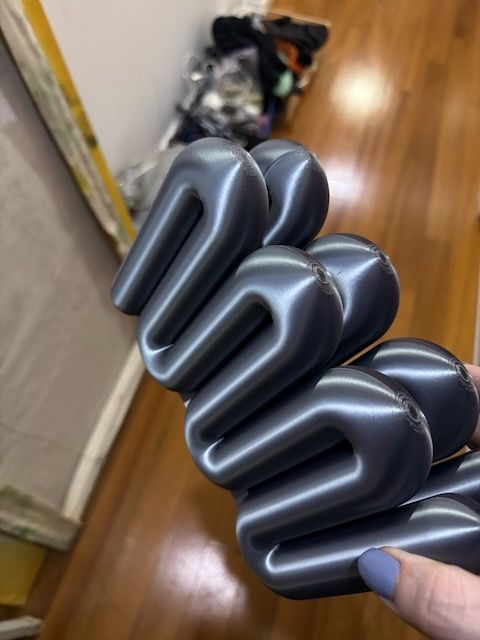
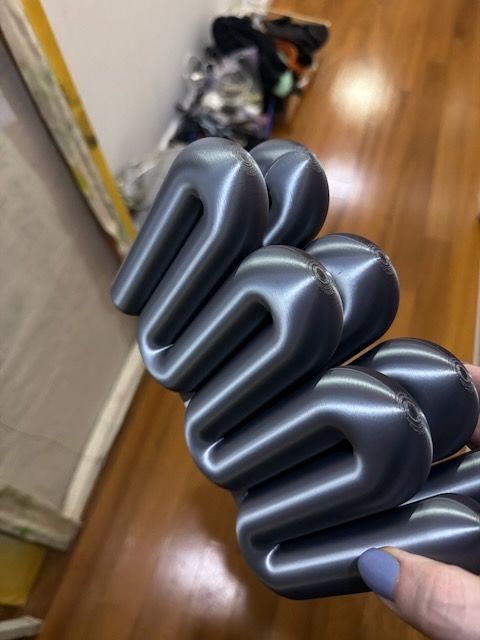
Take a look at the photographs accompanying this article.
The first shows my Bambu printer at work. The second shows the finished pieces: a rather beautiful set of dark, sculptural supports that together make a stand for my MacBook Pro.
The design has sweeping curves, rounded edges and an almost futuristic appearance. I rather like the finish, too. The visible print layers follow the contours of the objects, giving them a distinctive texture.
It's an interesting-looking piece of equipment, but more importantly, it's useful.
Now, you might wonder what a laptop stand has to do with photography.
Everything, as far as I'm concerned.
My MacBook Pro is an essential part of my photographic workflow. It's where photographs are imported, reviewed, edited, organized, prepared for printing, and ultimately published.
A camera captures the photograph. The computer is where so much of the remaining work happens.
And that makes the computer — and the equipment supporting it — part of my photography kit.
The really interesting thing is that I can make something like this myself.
Rather than simply browsing online for another accessory, I can find a design, print it, and potentially modify or replace it to better suit my needs.
There's something wonderfully satisfying about watching a useful object slowly emerge from a machine and then putting it to work.
Of course, it's also rather addictive.
You start by printing something practical, and before long you're looking around the house wondering what else you could make.
Camera Filters That Create Impossible Bokeh
This is where 3D printing becomes particularly exciting to me as a photographer.
I've also been printing custom camera filters designed to create unusual bokeh patterns.
If you're unfamiliar with bokeh, it's the appearance of the out-of-focus areas in a photograph, particularly those beautiful soft circles of light that appear behind a subject when shooting with a wide aperture.
Normally, those highlights take on a shape influenced by the lens aperture.
But what happens when you place a carefully shaped opening in front of the lens?
Those circles can become something entirely different.
Hearts. Stars. Dogs. And all sorts of strange and wonderful shapes.
The principle is wonderfully simple. A shaped opening can influence the appearance of out-of-focus points of light, turning ordinary background highlights into recognizable patterns.
And with a 3D printer, you can experiment with different shapes and designs without having to rely entirely on commercially available accessories.
Imagine a portrait taken against a background of twinkling lights, except those lights become little hearts.
Or a photograph of a dog where the background highlights take on tiny dog-shaped silhouettes.
Or a more abstract image filled with repeating stars.
There are so many possibilities.
I've always enjoyed experimenting with photographic filters and optical effects. I have a considerable collection of conventional and creative filters, but 3D printing opens another door.
Instead of asking whether somebody manufactures the particular effect I want, I can start thinking about how I might make it myself.
There is a technical limitation worth understanding: shaped bokeh works best with bright, out-of-focus points of light, a suitable fast lens and the right geometry between the lens and the shaped opening. Not every shape or lens combination will produce a crisp result.
But that's part of the experimentation.
Sometimes the unexpected results are the most interesting.
Why Bambu Lab?
When I became interested in 3D printing, I wanted something that would let me spend more time making things and less time fighting with the machine.
That's what drew me towards Bambu Lab.
One of the things I appreciate about the Bambu ecosystem is how much of the printing process can be handled through its software and connected tools.
There's Bambu Studio, which prepares models for printing, and MakerWorld, where people share an enormous variety of printable designs.
You don't have to become an expert in 3D modelling before you can make something useful.
You can begin with an existing design, learn how it works, and gradually move towards adapting or creating your own.
That accessibility is a big part of the attraction for me.
As a photographer, I'm already accustomed to working with technology, experimenting with settings, learning new techniques, and occasionally discovering that something has gone spectacularly wrong.
3D printing feels surprisingly familiar.
There's a creative idea, a technical process, some trial and error, and eventually a finished result.
Not every print goes perfectly. Designs can fail, settings sometimes need adjustment, and different materials have different strengths and limitations.
But when you get it right, the results can be remarkable.
Interested in trying a Bambu Lab 3D printer?
If you've been thinking about getting into 3D printing, I encourage you to have a look at Bambu Lab.
Whether you're a photographer, an artist, a hobbyist, or simply someone who enjoys making things, the possibilities go well beyond what you might first imagine.
Explore Bambu Lab 3D printers through my referral link
What Else Could a Photographer Make?
This is the part that really gets my imagination going.
Once you start thinking about a 3D printer as a tool for photography rather than simply a machine for producing plastic objects, the possibilities become rather extensive.
Custom Light Modifiers
Lighting is one of my favourite areas of photography to experiment with, and 3D printing could be particularly useful here.
Think about custom gobos — shaped objects placed in front of a light source to project patterns, shadows or textures onto a subject or background.
I already use gobos and optical snoots in my photography, so being able to create entirely new patterns would be fascinating.
You could experiment with geometric shapes, abstract patterns, window-like shadows, or designs created specifically for an individual photograph.
There are also possibilities for making holders, brackets, grids, and adapters for certain lighting accessories.
Of course, material choice matters. Many common 3D-printing plastics aren't suitable for contact with hot lights, and anything supporting heavy equipment needs to be properly engineered.
But for appropriate low-heat applications, the creative potential is enormous.
Camera and Lens Accessories
There are plenty of smaller objects that could be useful around a photography studio.
Custom lens-cap holders, cable organizers, equipment labels, filter storage systems, and specialized mounting accessories are all possibilities.
You might even be able to design an accessory for a piece of equipment that is no longer supported by its manufacturer.
I'm particularly interested in the idea of making small, purpose-built tools that solve problems specific to the way I work.
Sometimes what you need isn't an expensive new piece of equipment.
It's a simple little bracket that nobody happens to manufacture.
Macro Photography Tools
Macro photography is another area where 3D printing could be extremely useful.
Small positioning platforms, backgrounds, subject holders and lighting supports could all help when working with tiny objects.
I photograph close-up and experimental subjects, and being able to create precisely sized accessories could make certain setups much easier.
You could even make custom shapes and textures specifically to photograph.
Which raises another interesting possibility: printing the subject itself.
Props for Portraits, Boudoir and Fine-Art Photography
Imagine designing objects specifically for a photograph.
Unusual sculptural forms, geometric props, textured surfaces, decorative elements or abstract shapes could all become part of a creative shoot.
The objects wouldn't necessarily need to have any practical function.
They might exist simply because they look interesting under the right lighting.
And that, to me, is one of the most exciting connections between 3D printing and photography.
It's not just about making equipment.
It's about making things to photograph.
From Photographer to Maker
Photography has always involved a mixture of artistic vision and technical problem-solving.
You imagine an image, then work out what you need to do to create it.
Sometimes that means selecting the right lens. Sometimes it means modifying the light. Sometimes it means building an entire setup around a particular idea.
Having a 3D printer adds another option.
Instead of adapting your idea to whatever equipment is available, you can sometimes adapt the equipment to your idea.
And once you realize that, it's difficult not to start imagining all the things you might make.
My MacBook Pro stand is a good example of the practical side of 3D printing.
My custom bokeh filters represent the more experimental side.
And I suspect both are just the beginning.
Would I Recommend Bambu Lab?
If you're curious about getting into 3D printing, I'd certainly encourage you to investigate Bambu Lab.
I particularly like the combination of the printers, software, and readily available community designs.
It's a system that can make getting started feel much more approachable, while still offering plenty of room to learn and experiment.
I wouldn't suggest that everyone needs a 3D printer.
But if you're a creative person who enjoys experimenting, making things, or solving practical problems, you might be surprised how frequently you find yourself using one.
Take a look at Bambu Lab's range of 3D printers here
That's my personal referral link, and eligible purchases may earn me a referral reward. If this article inspires you to explore 3D printing, using it is a simple way to support my creative work.
Where Photography and 3D Printing Meet
I don't know yet exactly where this combination of interests will take me.
There are already more things I'd like to print, more photographic effects I'd like to experiment with, and certainly more than a few impractical ideas that will probably be worth trying simply because they sound interesting.
And that's really what makes it exciting.
Photography doesn't begin and end with pressing the shutter button.
It involves everything that helps you imagine, create, shape, and finish an image.
Sometimes that means a new lens.
Sometimes it's a lighting modifier.
And sometimes, apparently, it's a 3D printer quietly producing a rather futuristic-looking stand for my MacBook Pro.
I have a feeling this particular piece of equipment is going to keep me entertained for quite some time.
Kian Charles Gray Photography
Vancouver, British Columbia
www.kian.photography