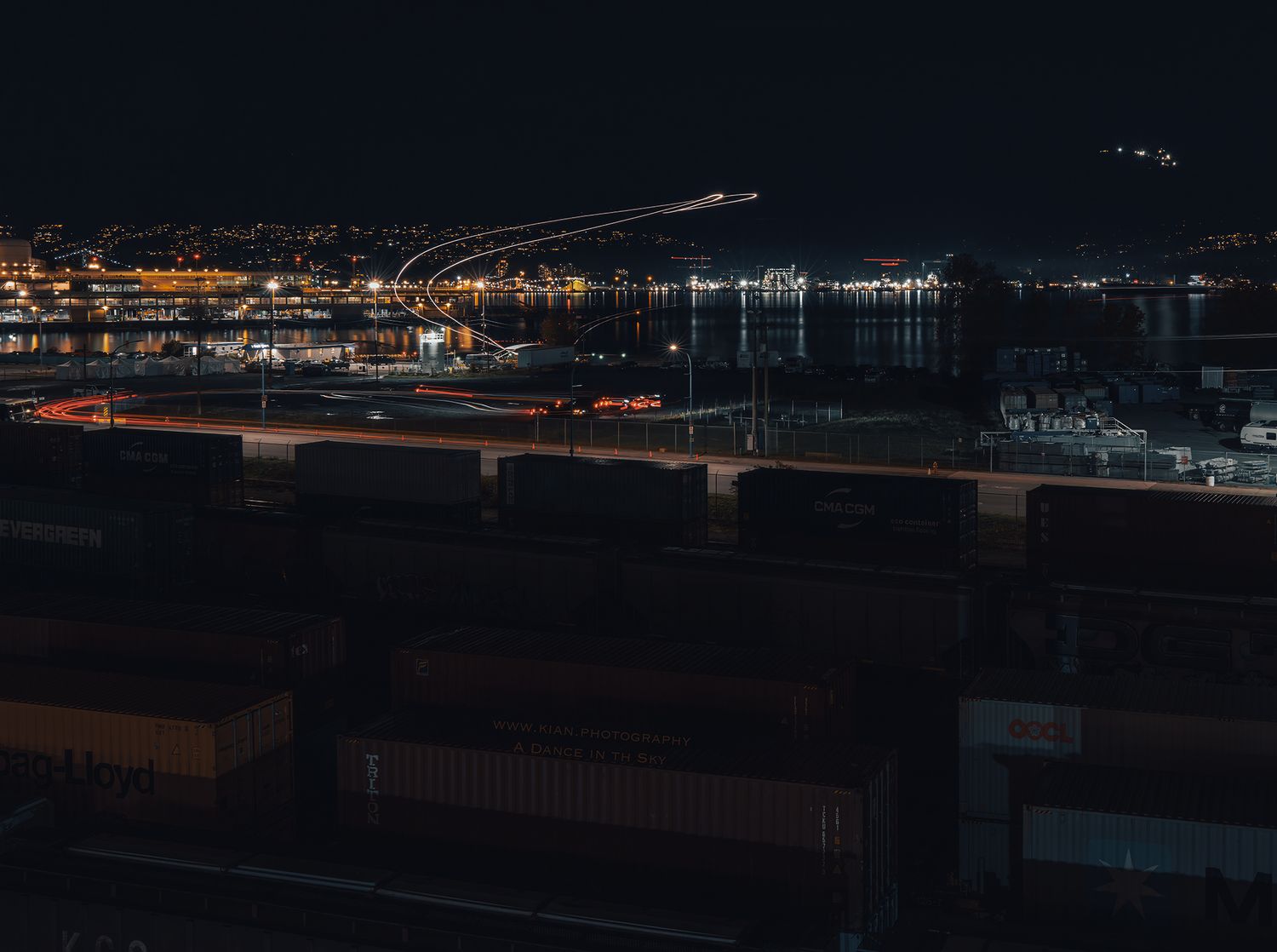
A Dance in the Sky
There are certain things you see as a photographer that stay with you. Not necessarily because they're spectacular in the conventional sense, but because you recognise something extraordinary in an otherwise ordinary moment.
For me, one of those moments has been watching helicopters manoeuvre over Vancouver Harbour.
I've now witnessed this particular flight pattern several times. A helicopter approaches the heliport, descends, lands, takes off again, and repeats a series of movements that, from my vantage point, almost resemble a carefully choreographed performance.
Every time I've witnessed it, I've tried to capture it, but the manoeuvre happens so quickly that getting the camera set up and the exposure started in time has proven challenging.
Last night, I finally managed to get closer to that vision.
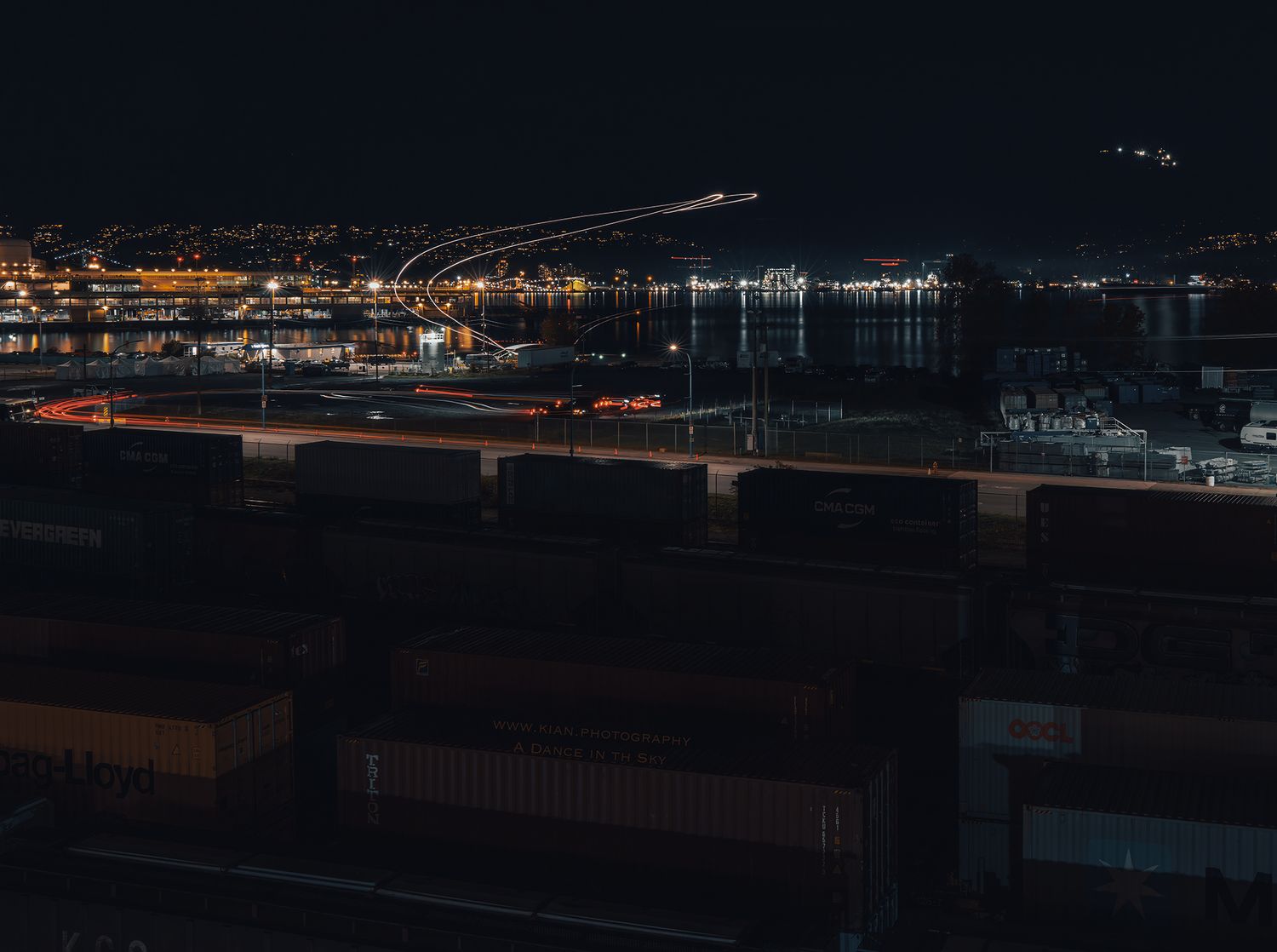
And so, A Dance in the Sky was born.
Six Minutes in a Single Photograph
The beautiful thing about long-exposure photography is its ability to show us something that doesn't exist in quite the same way to the human eye.
We experience time as a succession of moments. A helicopter approaches, changes direction, descends, and disappears from view. Each movement replaces the previous one.
A camera, however, can collect those moments and preserve them together.
For this photograph, I left the shutter open for approximately six minutes.
During those six minutes, the helicopter moved through the night sky, its lights tracing a continuous path across the scene. What I witnessed as a sequence of separate movements became a sweeping, almost sculptural line of light.
The resulting trail seems to float above the harbour, twisting and curving in a way that immediately reminded me of a dancer.
It's an interesting contradiction.
The helicopter is a machine, governed by engineering, aerodynamics, and the precise actions of its pilot. Yet when you remove the machine itself and leave behind only the evidence of its movement, the result can look unexpectedly organic.
Almost graceful.
Finding the Right Exposure
Photographing something like this presents an interesting technical challenge.
Vancouver Harbour is hardly a dark environment. Even late at night, there is an enormous amount of artificial light coming from the waterfront, buildings, industrial facilities, roadways, and surrounding neighbourhoods.
A six-minute exposure would collect a tremendous amount of that light.
The challenge was to keep the shutter open long enough to record the helicopter's movements without allowing the rest of the scene to become excessively bright.
For this photograph, I used my Sony A7R III, with the following exposure settings:
- Exposure: Approximately 6 minutes
- ISO: 50
- Aperture: f/16
- Filters: Maven 4-stop ND and 2-stop ND, stacked for approximately 6 stops of light reduction
Neutral-density filters are an essential part of creating long exposures in situations where there is more light than you want entering the camera.
In this case, combining the two filters allowed me to reduce the incoming light by approximately six stops.
That reduction was critical to achieving the exposure length I wanted.
The smaller f/16 aperture also helped limit the light entering the lens while producing pronounced starburst effects around some of the harbour's brighter lights.
One of the things I particularly enjoy about this image is that the helicopter isn't the only thing moving.
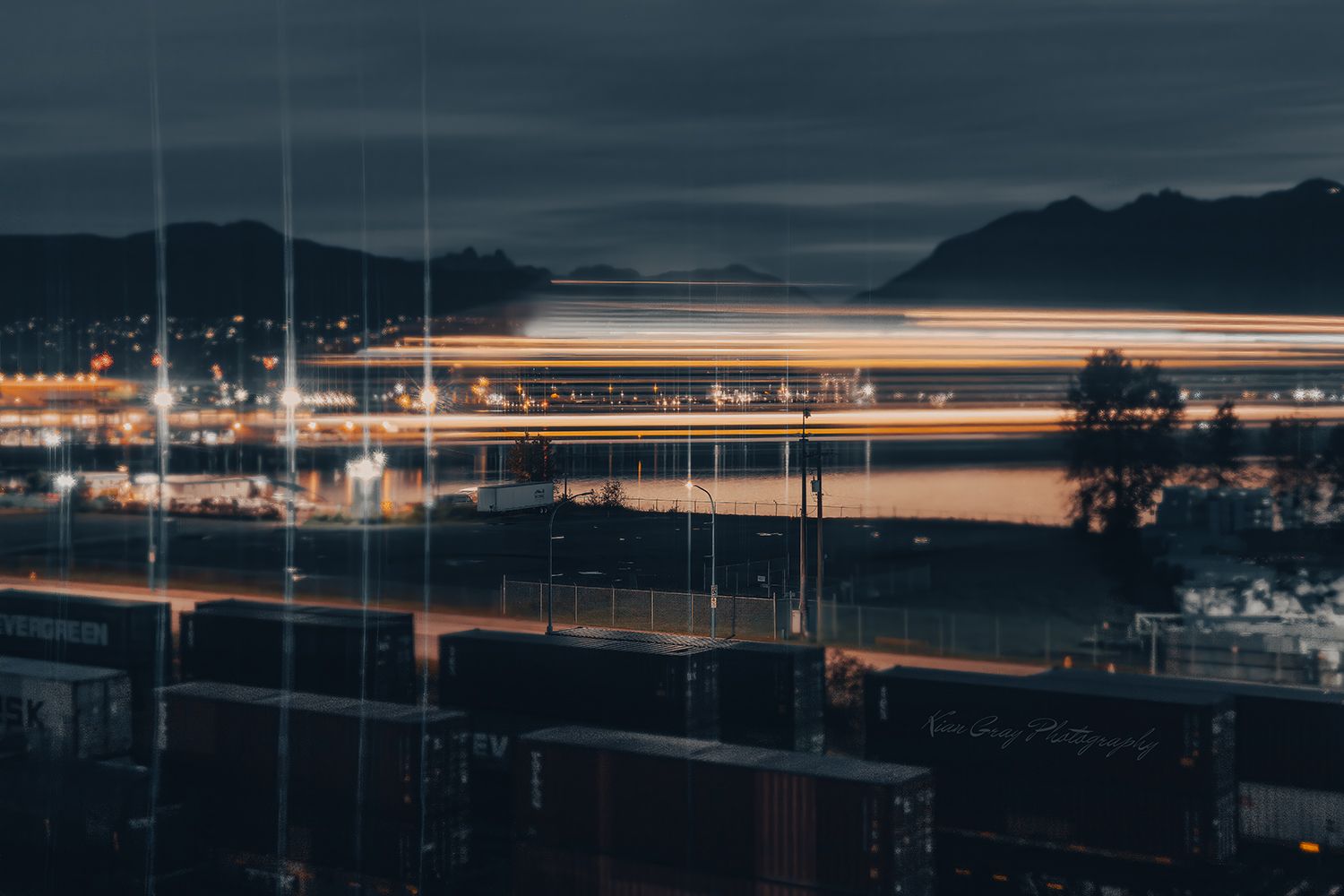
Look closely at the foreground and you'll see the light trails of vehicles travelling through the port area.
The waterfront itself remains relatively still, while the lights of moving objects record their paths through the scene.
It's a photograph of a place, but it's also a photograph of time passing through that place.
An Unexpected Film Crew
There was something else happening last night that made the entire experience particularly interesting.
The helicopter wasn't alone.
A drone was operating nearby, apparently filming the helicopter as it performed its manoeuvres.
As someone who also flies drones, I found this fascinating.
Flying a drone near an active heliport isn't something you can simply decide to do. Canadian aviation regulations place significant restrictions on drone operations around aircraft and controlled airspace, and specialized operations require appropriate authorization and coordination.
Initially, I was surprised to see a drone operating so close to the helicopter.
But as I continued watching, it became increasingly apparent that this wasn't an ordinary recreational drone flight.
The movements appeared coordinated, and the drone seemed to be part of a professional filming operation.
What finally convinced me that the two were working together was watching the drone return to the heliport and land after the helicopter had completed its manoeuvres.
I have no idea what they were filming or where the footage will eventually appear.
Perhaps it was promotional material. Perhaps something for a television production. Perhaps a commercial project.
Whatever the purpose, I would certainly love to see what they captured.
It's rather amusing to think that while someone was filming the helicopter from another aircraft, I was standing some distance away trying to turn the entire performance into one photograph.
Two very different ways of recording the same event.
The Photograph I Haven't Taken Yet
s much as I enjoy this image, it isn't quite the photograph I've been trying to make.
That's something I think photographers understand particularly well.
Sometimes you see an image before you've actually created it.
You know the composition. You understand the subject. You can imagine how the light should behave and how the different elements might come together.
But translating that image from your imagination into a finished photograph can take several attempts.
Sometimes many attempts.
I've watched these helicopter movements before, and each time I've learned a little more about how they unfold.
Where the aircraft approaches from. How it moves through the sky. How long certain manoeuvres take.
With long-exposure photography, that knowledge becomes especially valuable because so much of the process involves anticipation.
Once the shutter opens, you've committed to recording whatever happens next.
You can't rewind six minutes and ask the helicopter to try again.
And that's part of what makes this kind of photography so rewarding.
There is planning involved, certainly. Technical knowledge matters. Experience matters.
But there is always an element of chance.
When the Ordinary Becomes Extraordinary
One of the reasons I enjoy photographing Vancouver is that the city constantly presents opportunities to see familiar places differently.
The working waterfront is a perfect example.
Shipping containers, industrial facilities, roads, cranes, aircraft, and boats aren't necessarily subjects people immediately associate with fine-art photography.
Yet these places are filled with movement, geometry, light, and an extraordinary amount of visual complexity.
I've photographed Vancouver Harbour many times, and I'm continually surprised by how different it can appear depending on the hour, the weather, the light, and the technique I choose to use.
A six-minute exposure changes everything.
The industrial waterfront becomes a quiet stage.
The helicopter becomes a line of light.
The passage of time becomes visible.
And something as practical as an aircraft approaching a heliport becomes, at least for a moment, something resembling a dance.
A Work Still in Progress
I'll be returning to this photograph for further editing, and I have another exposure from the evening that I want to explore.
I suspect I'll also be watching the skies over Vancouver Harbour again, hoping to catch another opportunity to photograph these movements.
There are a few things I'd like to improve, and I already have some ideas about how I might approach the next attempt.
But that's photography.
Sometimes you spend an evening making photographs.
Other times, you spend an evening learning how to make the photograph you really want.
Last night was a little of both.
And for now, I'm rather pleased to have captured six minutes of Vancouver's night sky in a way that makes an ordinary helicopter look like it was dancing.
A Dance in the Sky.
Kian Charles Gray Photography — Vancouver, British Columbia
Explore more of my fine-art and long-exposure photography at www.kian.photography