view and purchase this fine art print.
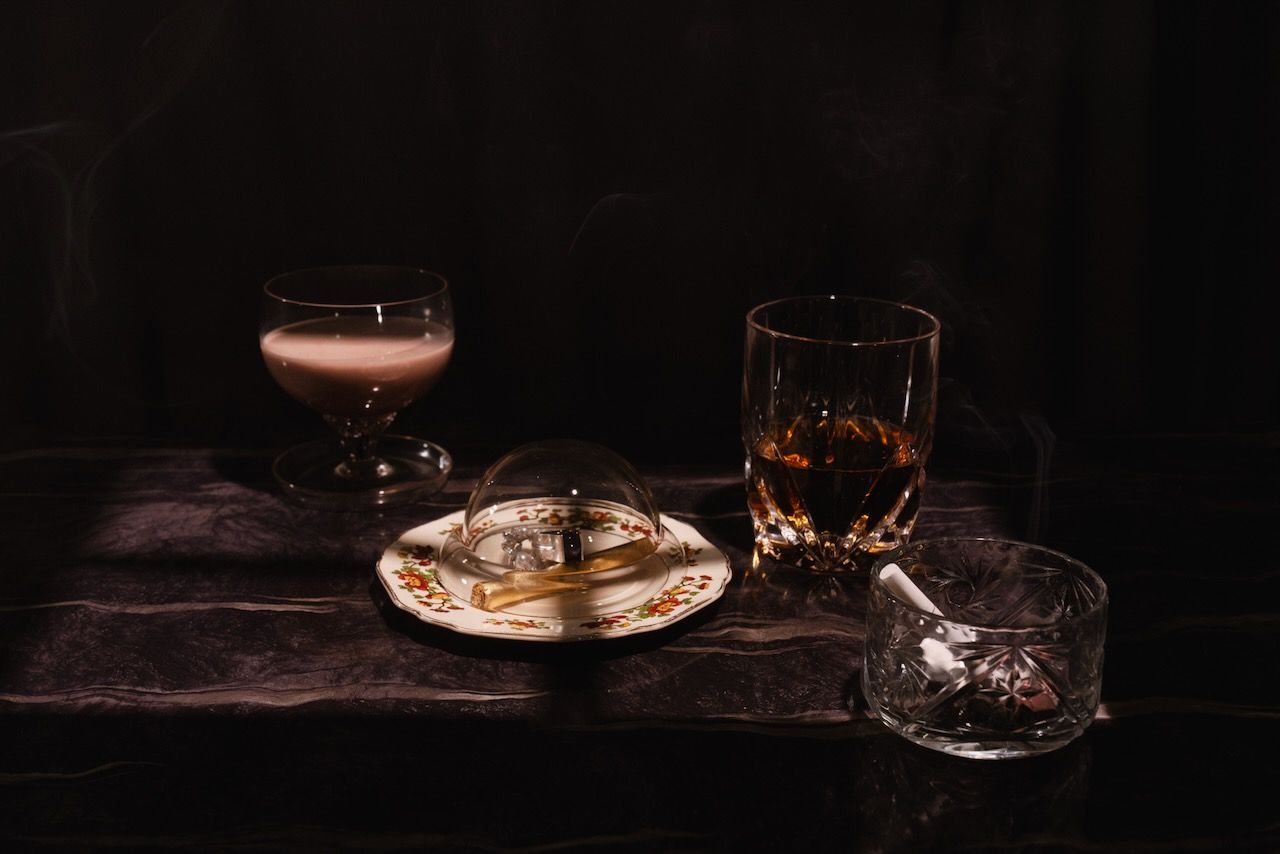
The cloche and plate are my grandmother’s. The joint is wrapped in 24-karat gold paper. Nearby, chocolate milk sits in a stemmed glass, an amber drink catches the light, and a crystal ashtray waits at the edge of the arrangement.
Everything has been given a place. Everything looks a little too good to leave alone.
This photograph is part of An Atlas of Favourite Songs, my ongoing project translating music into photographs. For this image, the starting point was Rufus Wainwright’s “Cigarettes and Chocolate Milk.” The title provides objects I can put on a table. The more interesting challenge is giving those objects the attraction, self-awareness and unease I hear in the song.
What I hear in Rufus Wainwright’s song
Wainwright’s work moves comfortably between songwriting and theatrical forms; his career also includes opera and his celebrated Judy Garland performances. That theatrical sensibility makes a carefully staged still life feel like a natural conversation with his music. “Cigarettes and Chocolate Milk” belongs to Poses, his second studio album, released in 2001. Wainwright’s biography; Poses.
The cravings have a very literal origin. In an interview about his songs, Wainwright recalled drinking chocolate milk while hungover and then lighting a cigarette outside New York’s Chelsea Hotel. He also connected the song to a period of pleasure, drinking and drugs, with an awareness beginning to emerge that the arrangement could not remain innocent forever.
What interests me is that awareness inside the attraction. The song does not make desire disappear by recognising its consequences. For my photograph, that leaves room for beauty that is persuasive and slightly uncomfortable at the same time.
My grandmother’s plate and a gold-wrapped joint
The cloche—the glass dome at the centre—and the floral plate bring a family connection into the arrangement. These objects already belong to my life. Putting them into the photograph gives the setting a personal specificity that newly bought props could not supply.
Beside that domestic connection sits the extravagance of the joint wrapped in 24-karat gold paper. It is an almost absurd degree of luxury for something intended to be consumed. Gold usually suggests something lasting and valuable; here it dresses something temporary.
That contradiction gives me a way into the song. The glassware lends ceremony to appetite. Milk becomes an occasion, and the cloche gives the joint the attention of a precious exhibit. There is pleasure in that elevation, but also a question about how carefully we dress up the things we want.
Building attention through light
I made this frame with my Sony A7R III and FE 24–70mm f/2.8 GM, set to 43mm, 1/250 second, f/8 and ISO 250.
For the patterned light, I used a snoot and gobos, with a Godox AD200 providing additional illumination. A snoot confines the light to a smaller area; a gobo is a patterned mask placed in its path to shape where the light falls. Together, they let me introduce a pattern of light and shadow into the set.
That control matters in a scene made from reflective objects. I want the light to reveal selected edges and surfaces while leaving enough darkness around them for the arrangement to feel intimate. The pattern adds to the theatrical character of the image, as though this little table occupies its own stage.
For a reader unfamiliar with those settings, f/8 is a moderately small aperture. It helps keep useful depth across a tabletop arrangement, where the objects occupy several different distances from the camera. It does not make every part of the scene equally sharp, but it gives the objects enough definition for their materials to matter.
The crucial lighting question is what remains visible. Glass can disappear into darkness unless a reflection describes its edge. Too much reflected light can turn it into a distracting white patch. Here, narrow highlights trace the rims and facets, while the liquid inside the taller glass holds a warm glow.
The background falls close to black. Light reveals the fabric’s folds across the table, then lets them recede. That is what photographers mean by a low-key image: much of the picture occupies the darker end of the tonal scale. The result can still contain precise, bright detail.
The photograph’s quiet tension
The arrangement leads my eye from the pale milk at the rear left, through the plate, to the taller amber glass and forward into the ashtray. Those changes in height and depth keep the still life from becoming a row of props.
The floral plate is particularly useful. Its domestic prettiness sits among darker, heavier materials. The pale surface also gives the eye somewhere to pause before returning to the shadows. Around it, the warm brown and muted plum tones make the photograph feel intimate, while the black space above leaves the scene unresolved.
For me, that empty space suggests an absent person. The objects are ready, or have been used, but the photograph does not settle the sequence. It leaves the viewer to decide whether this is anticipation, habit or what remains afterwards.
That openness is central to how I want these song photographs to work. A viewer who knows Wainwright’s music can bring it into the image. Someone who has never heard the song can still read the materials, the light and the uncomfortable generosity of the table.
You can explore more of An Atlas of Favourite Songs on my blog, or view and purchase this fine art print. The image is my response to the music: a small, carefully lit space in which wanting something has become its own ritual.