This photograph is available as a fine art print. → View the print
There are some photographs you plan for. You research the location, study the light, choose the lens and wait for the moment you have imagined.
And then there are photographs that happen because, for a few seconds, you happen to be looking in the right direction with the right camera in your hands.
This was very definitely the second kind.
I had arrived back in Sri Lanka the previous day. On my first morning, bright and early, I took my camera outside near Thalawathugoda, just outside Colombo.
I had my 200–600mm lens mounted and the camera set for rapid continuous shooting. There wasn't a particular animal I was looking for. Sri Lanka has extraordinary wildlife, and my thinking was simply: be ready, because I have no idea what might appear.
Then, out of the corner of my eye, I saw movement.
Not much. A little hop.
But it was an odd enough movement that my brain immediately registered it.
Something moved. What was that?
I turned.
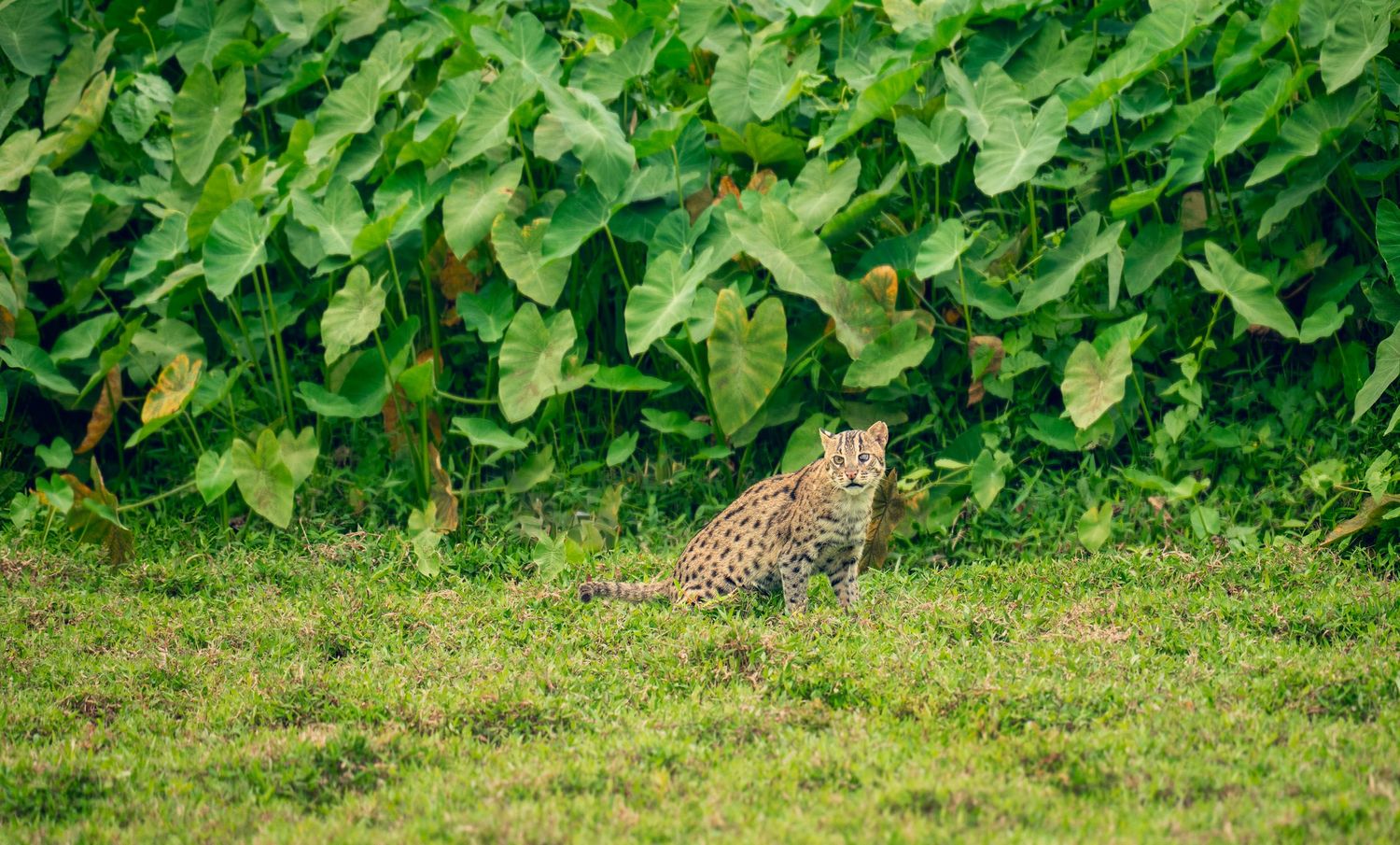
And there she was.
A fishing cat.
There wasn't time for careful composition or contemplation. I did what photographers rather inelegantly call spray and pray. The camera was already set up for speed, so I turned, focused and held down the shutter.
For those few seconds, I really had no idea what I was getting.
The cat was travelling with two kittens. Unfortunately, I didn't manage to photograph them. But their mother turned and looked back towards me.
That was the photograph.
The photograph everyone wanted to see
I spend about a month in Sri Lanka whenever I visit, and for the rest of that trip something rather funny happened.
I had photographed leopards. Sri Lanka's leopard is one of the country's great wildlife icons, and seeing one in the wild is extraordinary in itself.
But when I told people about the photographs I had made, the response was remarkably consistent.
They wanted to see the fishing cat.
Not the leopard.
The fishing cat.
Again and again, Sri Lankans would react with genuine amazement when I told them that I had seen one in the wild — and even more amazement when I showed them the photograph.
Many had never seen one themselves.
That reaction changed the way I thought about the image. I already knew I had been lucky. What I hadn't initially understood was just how unusual that few seconds had been.
What exactly is a fishing cat?
The fishing cat, Prionailurus viverrinus, is a wild cat native to parts of South and Southeast Asia. It is powerfully built, short-legged and beautifully adapted to an environment most people don't immediately associate with cats:
water.
Fishing cats are strongly associated with wetlands, marshes, mangroves and other watery habitats. Unlike the stereotypical cat avoiding the slightest splash, fishing cats are excellent swimmers. Their feet have partial webbing, their claws remain somewhat exposed even when retracted, and their dense coat helps insulate them in the water. National Zoo
And yes, they really do fish.
They hunt around the edges of waterways and take fish, but they are opportunistic predators and also eat small mammals, birds, amphibians and other prey. They have even been observed tapping the surface of the water, apparently attracting fish towards the movement before striking. National Zoo
They are also remarkably difficult to see.
Fishing cats tend to be elusive and largely nocturnal, and much about their behaviour in the wild remains poorly understood. Researchers often rely on camera traps and tracking technology simply to establish where populations still survive. National Zoo
A wild cat living beside a city
That is part of what makes Sri Lanka particularly fascinating.
Fishing cats have been documented not only in protected areas of the country but within and around the densely populated landscape of Colombo. Researchers have studied animals using the city's remaining wetlands, including the Thalawathugoda area. Fishing Cat Conservation Alliance
It creates an extraordinary contradiction.
One of Asia's elusive wild cats can be living remarkably close to millions of people — and most of those people may never know it is there.
Those wetlands are enormously important. They provide habitat for wildlife while also performing essential ecological functions in an increasingly urban landscape. Sri Lankan conservation researchers are studying fishing cats partly because protecting the cats means protecting the wetland systems upon which they depend. Fishing Cat Conservation Alliance
A species under pressure
The fishing cat is currently classified as Vulnerable on the IUCN Red List. The Fishing Cat Conservation Alliance identifies habitat loss and fragmentation, human-wildlife conflict and exploitation among the pressures facing the species. Wetland destruction is particularly serious because these environments form the centre of the fishing cat's ecology. Fishing Cat Conservation Alliance
The Smithsonian estimates that fewer than 10,000 fishing cats remain, while stressing how difficult these animals are to study. Urban expansion, wetland degradation, pollution, road deaths and conflict with people all contribute to the pressure on remaining populations. National Zoo
Which brings me back to that first morning.
I didn't hire a guide.
I wasn't on a fishing-cat expedition.
I hadn't spent days sitting beside a wetland waiting for one to emerge.
I had simply arrived in Sri Lanka, got up early, put the long lens on my camera and gone outside to see what the morning might give me.
And for a few extraordinary seconds, it gave me a fishing cat and her two kittens.
The kittens escaped my camera.
Their mother didn't.
She turned and looked back.
And I was ready.
Sometimes wildlife photography is research, planning, patience and technical skill.
And sometimes it is all of those things combined with one enormous piece of luck.
This was one of those times.
This encounter lasted only seconds, but the photograph has stayed with me ever since. The fishing cat looking back through the wetland is one of those images I still find hard to believe I was fortunate enough to make.
This photograph is available as a fine art print in my collection.
