Fourteen Stops Into the Fog
Sometimes I head out with a photograph in mind.
Sometimes the weather gives me something completely different.
And occasionally a helicopter pilot refuses to participate at all.
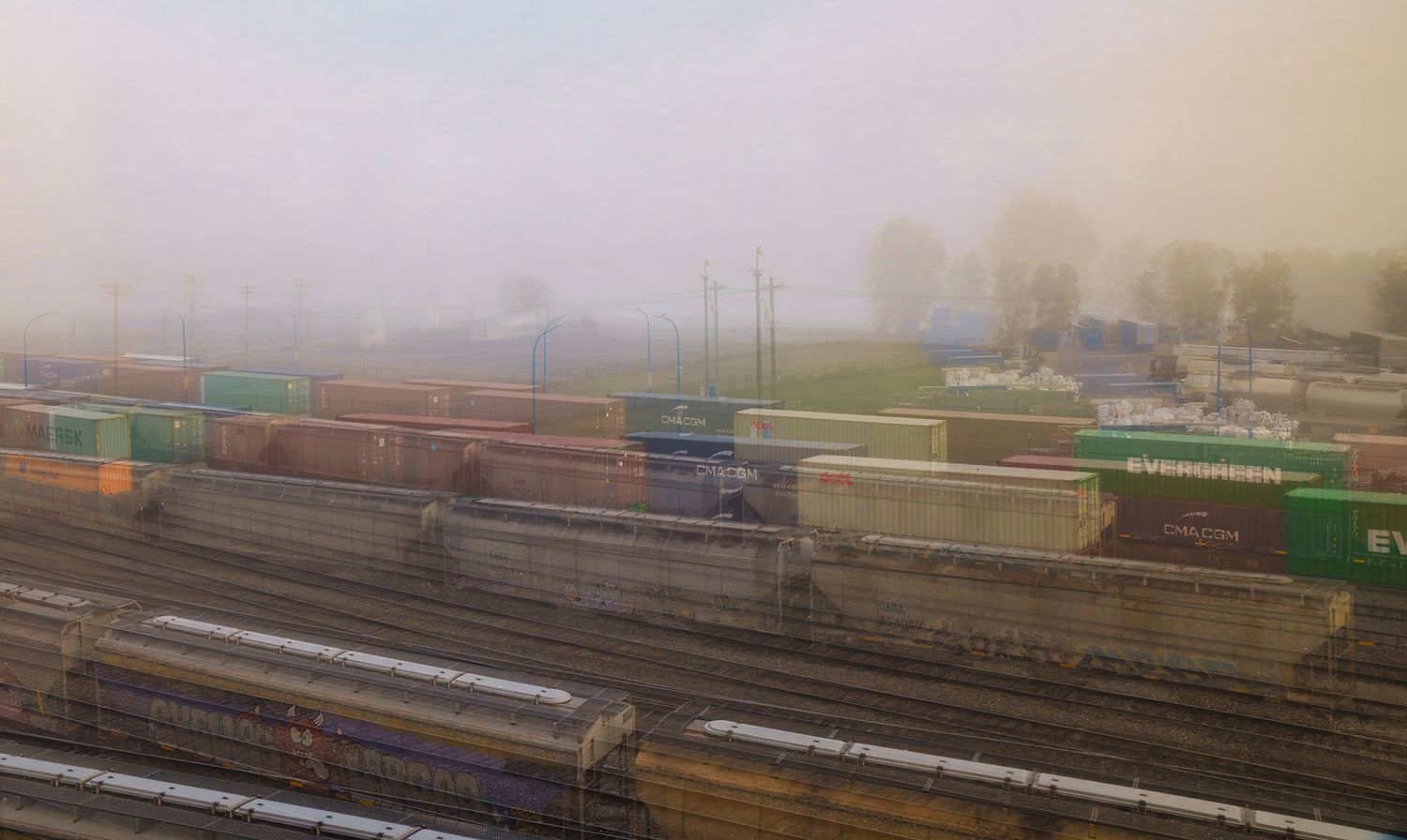
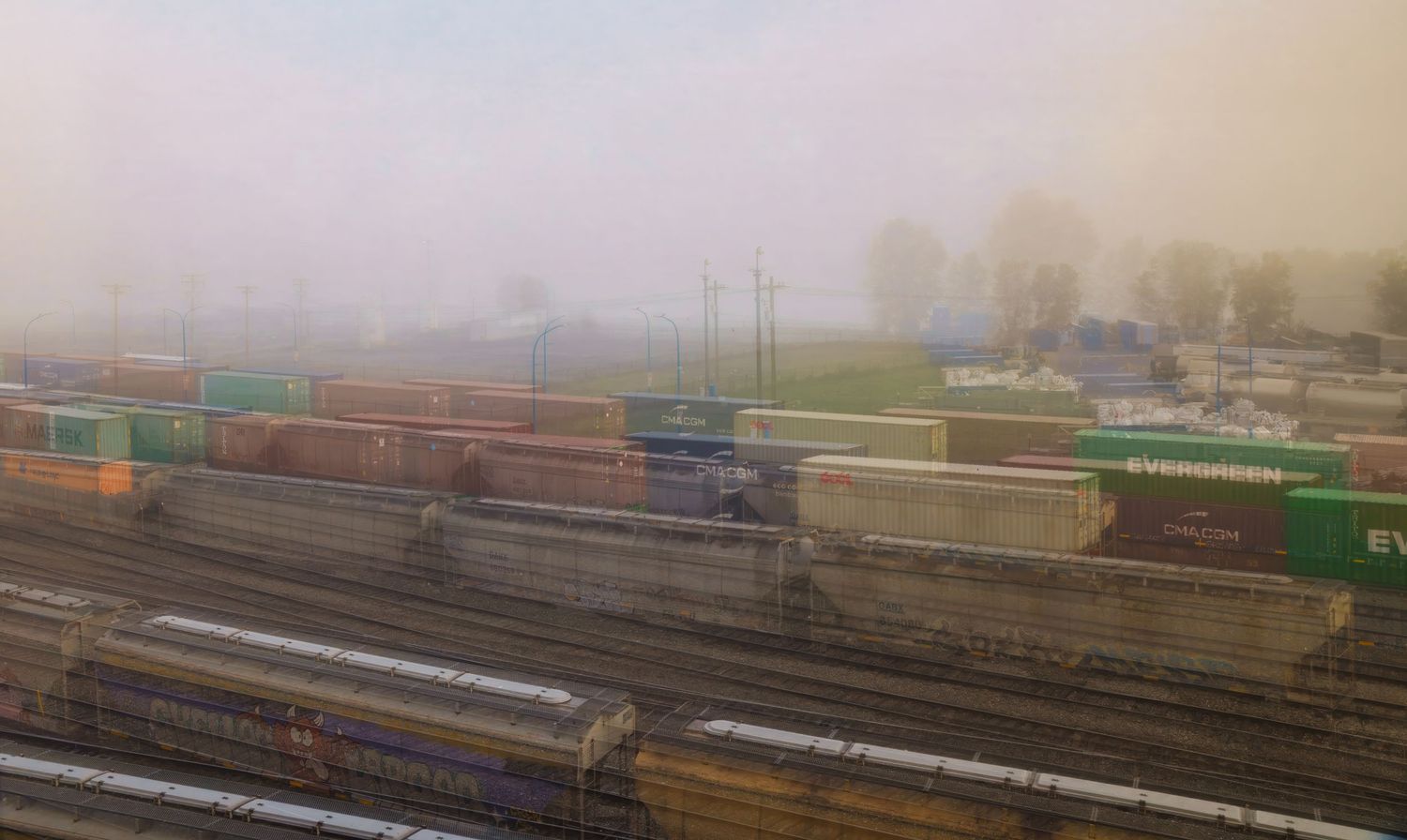
This photograph was made at around 8:00 in the morning on an exceptionally foggy Vancouver day. The industrial landscape below me — rail lines, freight cars, shipping containers, utility poles and trees — was disappearing progressively into what can only reasonably be described as soup.
Which, photographically, was rather wonderful.
I wanted to take advantage of the fog and make something that felt less like a straightforward photograph of the rail yard and more like a memory of one.
So I stacked a 10-stop and 4-stop neutral-density filter, giving me approximately 14 stops of light reduction, and moved into a substantially extended exposure.
Fourteen stops in daylight is a lot.
That was exactly the point.
Why use 14 stops?
An ND filter doesn't change the scene itself. It simply prevents light from reaching the sensor.
With enough reduction, the shutter can remain open far longer than would normally be possible during daylight.
Normally we associate that with smoothing water, turning clouds into streaks or removing crowds from busy locations.
Here, I wanted to use the long exposure differently.
The fog was already reducing contrast and erasing detail as the landscape receded into the distance. Extending the exposure allowed me to push that sense of time and uncertainty further.
But I also wanted to interfere with the photograph while the camera was actually making it.
Moving the lens during the exposure
During the exposure I manipulated the zoom ring, changing the focal length while the shutter remained open.
That means the camera wasn't recording one completely fixed projection of the scene.
As the focal length changed, objects shifted in scale and position on the sensor while the exposure continued.
You can see the result particularly clearly through the foreground rail cars and containers.
There is a second, translucent version of parts of the scene sitting over the first. Lines stretch and separate. Freight cars appear almost doubled. Some edges remain recognisable while others smear into the next position.
It's related to what is often called zoom blur or a zoom burst, although I wasn't interested in producing the classic dramatic lines exploding from the centre of the frame.
I wanted something quieter.
More like the landscape had moved while I was looking at it.
And in this fog, that worked.
And then there was the helicopter
There was actually another reason I was making the exposure.
A helicopter was coming in to land.
I thought this was perfect.
Heavy fog. Long exposure. Industrial landscape. A helicopter descending through it with its lights burning.
Those lights moving through the exposure could have left beautiful traces through the fog.
Except...
the helicopter didn't have its lights on.
Seriously.
Look at that soup.
Apparently the pilot and I had very different creative priorities that morning.
From a photographic point of view, the consequence was that the helicopter essentially disappeared from the final exposure.
A moving object doesn't necessarily vanish during a long exposure. What happens depends on its brightness, speed and how long it occupies any particular part of the frame.
If an object moves relatively quickly through a long exposure, the small amount of reflected light it contributes to each location can become so diluted that it appears only as a faint ghost — or doesn't become perceptible at all.
A bright helicopter light would have been different.
A concentrated source of light moving across the frame can leave a very obvious trail.
Which is precisely what I was hoping for.
Thanks, helicopter.
What the photograph became instead
Without that streak of light, the photograph became much quieter than I originally imagined.
And I think I actually like that.
The foreground has solidity: tracks, freight cars, graffiti, containers.
Then the scene gradually dissolves.
The further into the photograph you travel, the less certain everything becomes.
Containers become blocks of muted colour.
Utility poles emerge briefly and disappear again.
Trees become silhouettes.
Eventually there is almost nothing except fog and pale morning light.
The deliberate focal-length movement adds another layer of uncertainty. The lower part of the image feels as though two slightly different moments have been recorded on top of one another, while the background simply fades away.
There is something strangely dreamlike about it.
It isn't the photograph I went out intending to make.
But that happens surprisingly often.
Sometimes the interesting part of photography isn't successfully executing the picture you imagined.
It's noticing the picture you actually got.
And sometimes it's complaining about a helicopter pilot afterwards.
Kian Charles Gray
Kian Charles Gray Photography — Vancouver, Canada