Walking Apart — A Leopard in Wilpattu
There are photographs I like because of the light, photographs I like because of the subject, and others that become important because of what was happening inside me when I made them.
This is one of the latter.
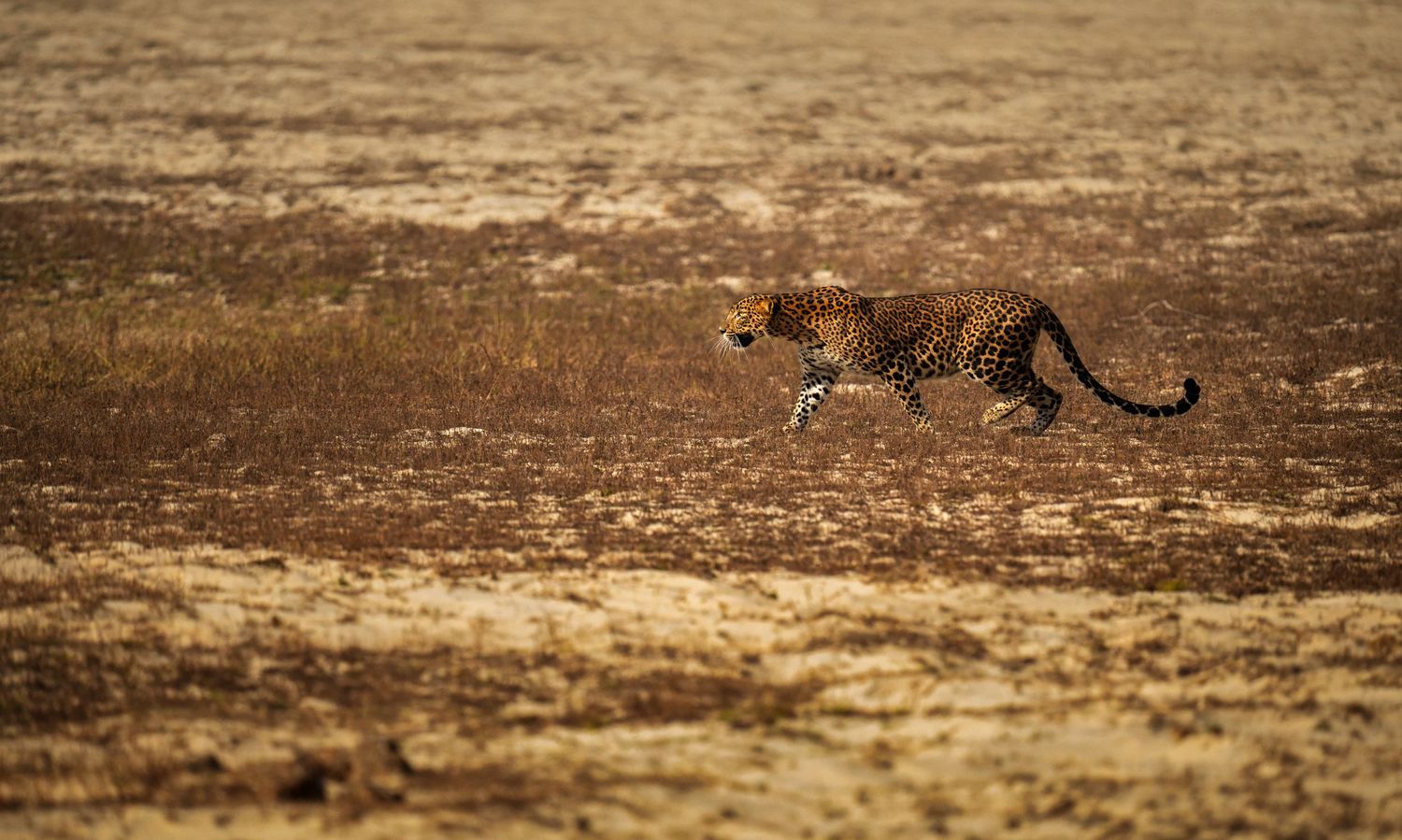
I took this photograph in Wilpattu National Park in Sri Lanka. We had encountered a leopard moving through the open, dry landscape. But it wasn't simply out for a walk. It was stalking something.
We never actually saw the animal that had attracted its attention, but something was out there. The leopard's posture, the concentration in its movements and the direction of its attention all suggested that it was responding to potential prey.
There was something extraordinary about watching such a beautiful animal so completely absorbed in its surroundings.
At the time, I was feeling somewhat apart from everything around me. Sri Lanka is a country I have loved and returned to for many years, and it is inseparably connected to people I love. But loving a place and feeling that you completely belong to it are not always the same thing.
Photography was feeling complicated for me as well. I had become unusually conscious of how other people saw my work, particularly my tendency to push an image beyond a straightforward representation of what was in front of the camera.
I like photographs with a point of view. I like colour, mood, contrast, texture and interpretation. I've never really wanted my photographs simply to say, this is what was there.
I want them to say something about what it felt like to be there.
Looking at this image again, that is exactly what I see.
Compositionally, the leopard occupies a relatively small portion of the frame. I wanted the landscape to remain an important part of the photograph. The long horizontal bands of pale sand, dry vegetation and earth create an almost abstract backdrop, interrupted by the remarkable patterns of the leopard's coat.
There is plenty of space ahead of the animal, allowing its direction of movement to become part of the composition. Its low head and forward attention suggest something happening beyond what we can see.
And then there is that tail. Curved upwards at the very end, it provides a wonderful little visual counterpoint to all those horizontal lines.
The edit is intentionally warm and earthy. The ochres, browns and muted greens allow the leopard to become part of the landscape rather than standing artificially apart from it. I've retained a richness in the coat and contrast in the markings, but I didn't want to turn the photograph into a conventional, tightly cropped wildlife portrait.
The landscape matters. The space matters. And what is happening beyond the frame matters.
What strikes me now is the sense of purpose in the animal. It had noticed something we hadn't. Its attention was elsewhere, focused on a world that, despite our presence, remained entirely its own.
I find something rather compelling about that.
Perhaps that is also why this photograph resonates with me personally. I wasn't feeling particularly connected to the world around me during that period, and yet photography still gave me a way of engaging with it on my own terms.
The leopard was hunting. I was photographing. We were both concentrating on something that mattered to us, although for very different reasons.
I don't know what became of whatever had attracted its attention. We never saw it.
But I came away with this photograph, and years later, it still has something to say to me.